
Face or fingerprint attendance: which is better for your team?
- Topic
- Biometric readers
- Reading time
- 7 min
- Sources
- 5 checked
Short answer
For most UAE offices and sites, face recognition is the better choice today: nobody touches the reader, staff do not stop to place a finger, and gloves or dirty hands are no problem. Fingerprint still suits small indoor teams on a tight budget. Both can take a card or PIN as a backup.
How face and fingerprint readers work
Both machines do the same job: they check who someone is and record the time. A fingerprint reader has a small glass sensor. Staff press a finger on it, and the reader compares the pattern with the ones it has stored. A face terminal has a camera, usually with an infrared light, and checks the face of the person standing in front of it.
Each reader turns the finger or face into a template: a set of numbers that describes it. Matching means comparing a new template with the ones enrolled. Liveness detection is the check that a real person is there, not a photo or a fake finger.
The reader sends each clock-in to attendance software such as Connect TimeLog, which turns the logs into shifts, hours worked and reports for HR.
Face vs fingerprint compared
Here is how the two compare on the points UAE buyers ask about most. Both work well when the right model is fitted in the right place.
| Factor | Face recognition | Fingerprint |
|---|---|---|
| Touch | No contact. Staff just look at the screen. | Every person touches the same sensor. |
| Gloves | No problem: gloves stay on. | Gloves must come off for every scan. |
| Dirty, wet or worn fingers | Not affected. | Reads can fail. Worn prints, common in building and cleaning work, can be hard to enrol. |
| Face masks | Depends on the model. Some recognise staff with a mask on; check the datasheet. | Not affected. |
| Caps, helmets and strong light | Can slow matching. Mounting height and lighting matter. | Not affected. |
| At a busy entrance | Hands-free, so the queue keeps moving. | Each person stops and places a finger. |
| Outdoor use | Choose an outdoor-rated model and keep it out of direct sun. | Choose an outdoor-rated model, for example IP65 or IP67. |
| Device price | Usually higher. | Usually lower. |
| Best for | Offices, busy shift changes, sites where people wear gloves. | Small indoor teams and tight budgets. |
When fingerprint is still the right choice
Fingerprint readers are proven, simple and usually cost less. They make sense when:
- Your team is small and works indoors, in a clean space.
- Budget matters more than speed at the door.
- You already have fingerprint readers and want more of the same kind.
- The reader has to fit a narrow door frame or a small wall space.
Fingerprint models to look at
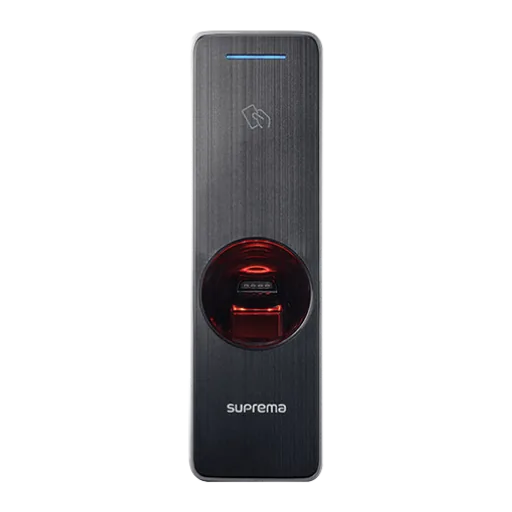
Suprema lists the BioEntry W2 and BioLite N2 as outdoor IP fingerprint devices, and the BioEntry P2 and R2 as compact fingerprint readers. HuAi and Virdi also make fingerprint terminals for attendance.
Give staff a backup either way. Most readers also accept an RFID card or a PIN, so a person whose fingerprint reads badly can still clock in.
When face recognition is the better choice
Face terminals cost more, but they solve the problems fingerprint readers struggle with. Pick face recognition when:
- Many people arrive at once, for example at a shift change.
- Staff wear gloves, or their hands are often dirty or wet: construction, factories, kitchens, cleaning and healthcare.
- You want no shared touch point at the entrance.
- The reader also opens a door or a speed gate, so people should not have to stop.
Face terminals we supply
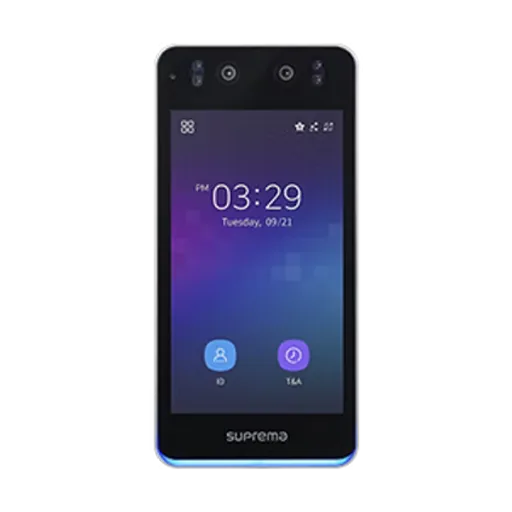
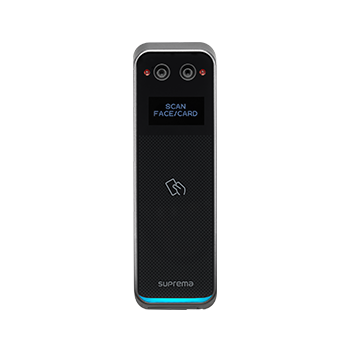
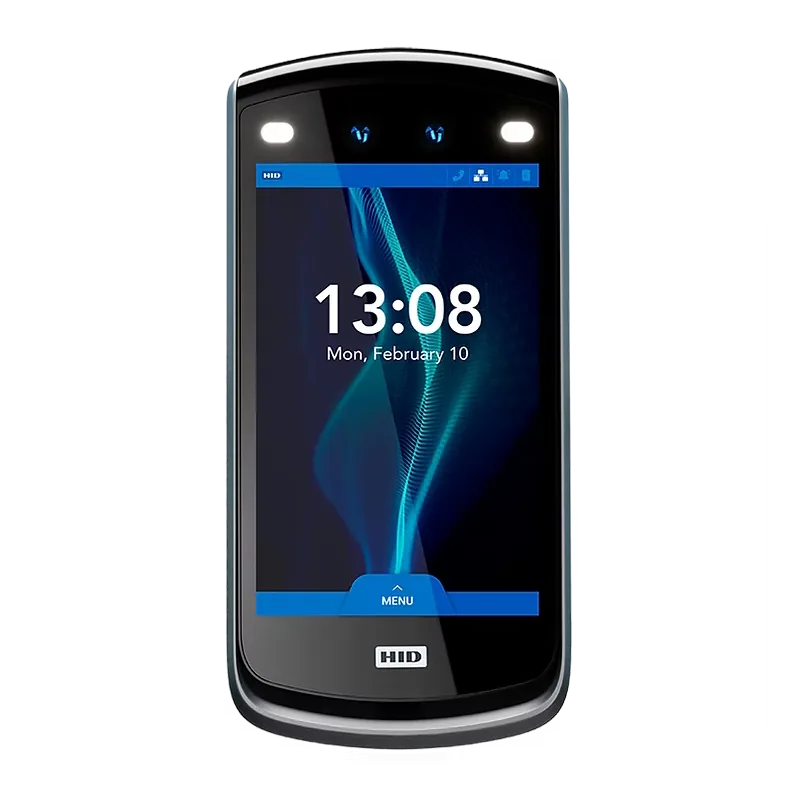
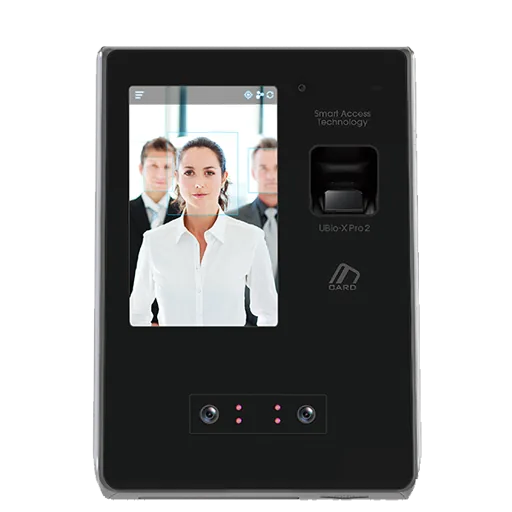
Current face terminals include the Suprema BioStation 3 and BioEntry W3, the HID Amico range, Virdi's UBio-X face terminals and HuAi face readers. For face attendance software, see LogIT FaceLog.
See every face and fingerprint model we carry on the biometric readers hub.
Construction sites, gates and outdoor walls
Outdoor readers in the UAE face heat, dust, strong sun and the odd heavy rain. Both types can work outside, but only models built for it. Check three things on the datasheet:
- IP rating: protection against dust and water. IP65 means dust-tight and safe from water jets. IP67 also survives short immersion.
- IK rating: resistance to knocks. A higher number means a tougher case, which matters on a public wall.
- Operating temperature: compare the top figure with the hottest spot on your site, including sun on a metal wall.
Sun, dust and where to mount the reader
Sun is the main problem for face cameras. Bright light behind the person, or sun shining straight into the lens, can stop a match. Fit the reader under a canopy or on a shaded wall, facing away from the afternoon sun.
For fingerprint readers outdoors, dust and sand on the sensor are the main issue, so plan regular cleaning. Send us photos of the wall or gate and we will suggest a model and a mounting spot.
Privacy and staff consent in the UAE
Fingerprints and faces are personal data. The UAE federal data protection law, Federal Decree-Law 45 of 2021 (the PDPL), took effect on 2 January 2022 and includes biometric data in its definition of personal data. It generally asks for clear, opt-in consent. Companies in the DIFC and ADGM free zones follow their own data protection laws instead.
Good practice, whichever law applies:
- Tell staff in writing what you collect, why, and who can see it.
- Think about a card or PIN option for anyone who does not want to use biometrics.
- Limit who can open the attendance software and export data.
- Delete templates when someone leaves the company.
- Ask the supplier whether the reader keeps face photos as well as templates, and where.
- This is general information, not legal advice. Speak to a UAE legal adviser about your own policy.
What changes the price
Prices depend on the site, so we quote each one. These are the things that move the price up or down:
| Cost item | What changes it |
|---|---|
| The reader | Face terminals usually cost more than fingerprint readers. Outdoor ratings, larger screens and more user capacity add to the price. |
| Credentials | Adding cards, mobile credentials or QR codes may need a different model or a licence. |
| Software | Attendance software may be a one-off licence or a subscription, priced per device, per user or per site. |
| Installation | Cable runs, network points or PoE (power over the network cable), the wall type, and whether the reader also opens a door. |
| Door hardware | If the reader controls a door you also need a lock, exit button, power supply and I/O module. See the door access parts list. |
| Support | On-site support, spare units and software updates. |
Get a price for your site
Send us the number of staff, the number of entrances and a photo of each spot on WhatsApp. We will reply with two or three options and today's price for each.
Products in this guide
Add what you need to one quote list, then send it by WhatsApp or email. We reply with prices and stock.

Sources we checked
Product facts come from the makers' own pages. Rules come from official or legal sources.
- 1Suprema security products lineupsupremainc.com
- 2UAE issues landmark personal data protection law (Clyde & Co) (opens in a new tab)clydeco.com
- 3HID's Amico makes global debut at Intersec Dubai 2025 (Zawya) (opens in a new tab)zawya.com
- 4Union Biometrics, maker of Virdi readersunionbiometrics.com
- 5HuAi productshuaiaccess.com
Questions buyers ask
Short, plain answers. If yours is not here, ask us on WhatsApp.
Does face recognition work if staff wear masks?
It depends on the model. Some face terminals can recognise people wearing a mask, while others ask them to lower it for a moment. Check the datasheet of the exact model, or ask us to show it working before you buy.
Which is faster at a busy entrance, face or fingerprint?
Face recognition is usually quicker in practice, because people do not stop to place a finger. The terminal matches them as they step up. For very busy entrances, pair face readers with speed gates.
Which is better for a construction site?
Face recognition, in most cases. Dust, cement and worn fingers make fingerprint reads fail, and gloves have to come off. Choose an outdoor-rated model, mount it in shade, and keep a card option as a backup.
Do staff have to agree to biometric attendance in the UAE?
Biometric data counts as personal data under the UAE PDPL (Federal Decree-Law 45 of 2021), which generally requires clear consent. The DIFC and ADGM have their own laws. Tell staff what you collect and why, and take legal advice on your policy.
Can we use face and fingerprint readers on the same site?
Yes. Connect TimeLog works with face, fingerprint and card machines from several makers (HuAi, Hikvision, Megvii, HID, Bosch and Innovatrics), so you can mix brands and reader types and see every clock-in in one place. A common setup is face readers at the main entrance and fingerprint readers at smaller doors.
Can staff clock in with a card or phone instead?
Yes. Many face and fingerprint terminals also read an RFID card or accept a PIN, and some accept a mobile credential. That gives a backup for anyone whose fingerprint does not read well.
Read next
Send us your list. We reply with prices and availability.
Not sure which one fits? Send us a photo of the site, the door or the card you use now. We suggest the parts, then supply, install and support them across the UAE.
- Company
- LogIT Solutions LLC
- Office
- Dubai Silicon Oasis
- In business
- 13+ years
- Phone
- +971 50 889 5653
- Offices
- UAE · India · Kenya